Articles

Market Flash: A small Budget keeps markets onside

calendar icon 29 October 2026
time icon 2 minutes

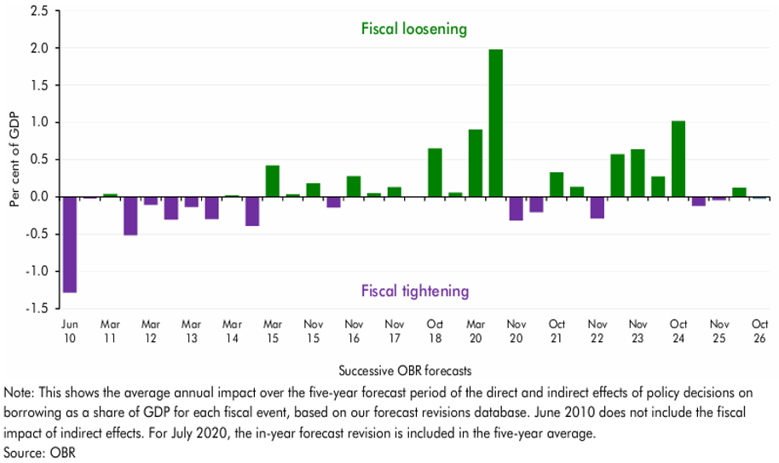
Compared to previous years, the Budget was far smaller in terms of tax and spending announcements (see below chart from the Office of Budget Responsibility (OBR)).

This means our views on the UK economy, UK equities, and gilts remain unchanged.

Area

Budget impact

Our view

UK economy

The Chancellor retained approximately £15bn of fiscal headroom, with no large unfunded spending commitments, but the OBR’s outlook has lower growth, higher inflation and higher borrowing.

Ultimately global, rather than UK, economic growth is likely to support global equity returns. Global growth remains relatively robust.

UK equities

Limited aggregate impact. The temporary increase in the Bank Surcharge was less severe than feared, supporting some bank shares.

The UK equity market, with its low exposure to technology and its traditionally higher dividend yield, continues to offer good diversification to global markets.

UK government bonds

The gilt market was comfortable with the Chancellor’s approach and yields changed little during the afternoon.

UK bond yields look attractive on valuation grounds, but there is a weaker technical backdrop as global bond issuance is high while demand from DB pension schemes falls.

Sterling

No major fiscal surprise or obvious loss of credibility.

Broadly neutral. We expect, like other asset classes, having exposure to a diverse set of currencies should support diversification.

Size of fiscal policy packages, 2010 to 2026

Economic outlook

The key points from the OBR’s assessment are that their forecast for growth is lower (except for 2026), inflation is higher and borrowing is higher. The energy impact from the conflict in the Middle East and higher gilt yields are key factors here. The Chancellor has opted to keep a smaller headroom against the fiscal rules of £15bn compared to £23.6bn in March. So far, the gilt markets are comfortable with this approach, as gilt yields were little changed over the afternoon. The composition of issuance by the Debt Management Office (DMO) continues to be managed quite deliberately. Issuance to the longer end of the gilt market, where demand is waning, continues to fall.

ISAs

For savers and investors, one policy of note was the reversal of the reduction of the cash ISA allowance. This was due to fall to £12,000 next April but will now remain at £20,000. We welcome this reversal as it added additional complexity to the ISA system, created challenging compliance issues for providers and there was little evidence that it would encourage investment (worst case it could discourage use of Stocks & Shares ISAs as people would fear falling foul of the tax charge on cash). However, its aim, to encourage more investing was an important one.

Recent research suggests that people are more than twice as likely to save for their retirement in cash rather than in a stocks and shares ISA. Such investors will have missed out on the strong returns we’re seeing from markets over recent years. For example, looking back 20 years, an investor with 20% invested in global equities and 80% in bank account cash, would now have more than two and a half the amount of assets, relative to someone who just held bank account cash over the period. The announcement of a new “Starter ISA” as an incentive for people investing in a stocks and shares ISA for the first time may support this aim. We look forward to seeing further details.


Risk warning 

This document is for intermediaries to be used for information purposes only. It does not constitute an offer or solicitation to invest, it is not advice or a personal recommendation nor does it take into account the particular investment objectives, financial situation or needs of individual clients. Whilst HRIS uses reasonable efforts to obtain information from sources which it believes to be reliable, HRIS makes no representation that the information in this document is accurate, reliable or complete.

The value of your investments and the income from them may go down as well as up and neither is guaranteed. Investors could get back less than they invested. Past performance is not a reliable indicator of future results. Changes in exchange rates and/or tax rates may have an adverse effect on the value of an investment. 

Sign up for our newsletter

We are constantly discussing the many issues facing and shaping our industry. Sign up to find out our current thinking on topical issues.

Subscribe
  • Latest industry thinking

  • Early access to upcoming events

  • Tailored relevant content

  • Access to exclusive content

  • Consumer duty insights

Subscribe